

When local authorities audit their operational carbon footprint, highways maintenance rarely gets the scrutiny it deserves.
Streetlighting gets measured. Fleet electrification gets strategised. Buildings get retrofit assessments. But road repair — the labour, the materials, the equipment, the repeated mobilisations to the same sites — tends to appear as an undifferentiated block in the carbon accounts, if it appears at all.
This is a significant gap. Road repair method is one of the largest variables in a highways department’s carbon output. The choice between traditional repair and spray injection patching is not a marginal sustainability improvement. The data shows it is a structural one.
The numbers
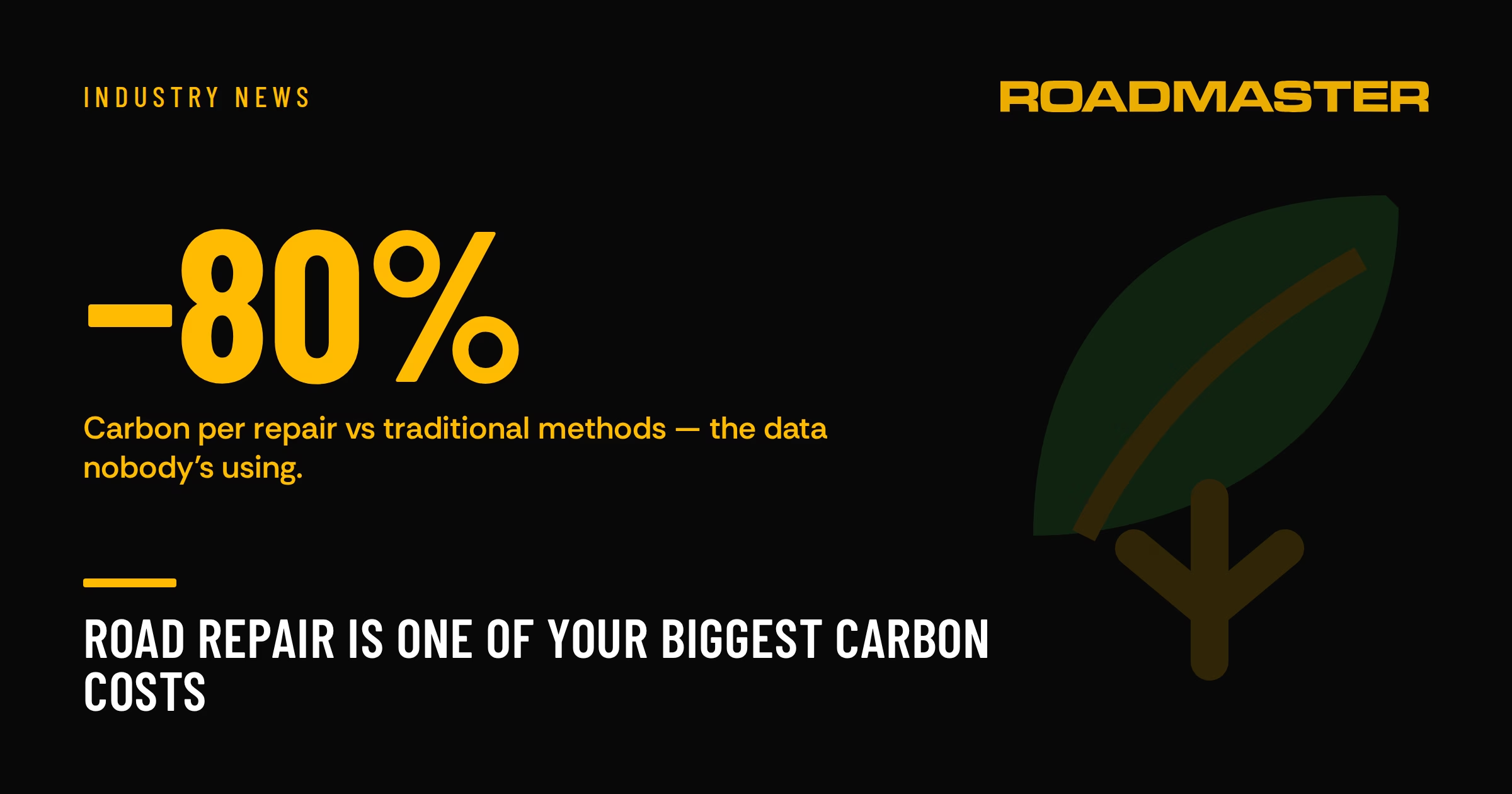
Per repair comparison: Spray injection patching produces approximately 0.8kg of CO₂ per repair. Traditional methods produce approximately 3.2kg. That is an 80% reduction per intervention, from the same starting point — a road defect that needs fixing.
Versus hand-lay: Volker Highways conducted an independent analysis in 2023 comparing spray injection patching to hand-lay repair methods. The result was a 96% carbon reduction. Hand-lay, which remains common for larger defect repairs, is one of the most carbon-intensive methods available.
Annualised: The East Ireland Municipal District trial in 2024 compared spray patching and manual labour on the same road network over time. Annualised over repair lifespan — accounting for the fact that spray patches last four times longer than traditional repairs and therefore require fewer repeat interventions — the carbon reduction was 75% per square metre maintained.
This last figure is the one that matters most for carbon accounting. A repair that holds for twelve months produces one carbon event per year at a given site. A repair that holds for three months produces four. The annualised carbon footprint of traditional repair is not just the per-repair figure multiplied by four — it also includes the repeated mobilisation, material transport, and equipment operation for each of those additional interventions.
Why repair method is rarely in the carbon conversation
The carbon argument for spray injection patching is almost entirely unmade in the market. There are two reasons for this.
The first is that highways carbon data is poorly disaggregated. Most authorities report total fleet emissions and total energy consumption. The carbon cost of individual repair methods — how much CO₂ per square metre maintained, by method — is rarely tracked at the operational level. Without that data, the comparison cannot be made internally, and the argument cannot be constructed.
The second is that the decision-makers for road repair method and the decision-makers for sustainability targets are usually different people, in different departments, working to different KPIs. The carbon case for spray injection patching sits at the intersection of two conversations that rarely happen in the same room.
HVO compatibility and the net zero trajectory
All current Roadmaster machines run on HVO — Hydrotreated Vegetable Oil — with no engine modification required. HVO reduces lifecycle carbon by approximately 90% compared to conventional diesel, without affecting engine performance or requiring infrastructure investment.
For authorities with net zero fleet commitments, this matters. A spray injection patcher running on HVO combines the 80% per-repair carbon reduction with a 90% reduction in fuel carbon — compounding the sustainability case significantly.
Hydrogen-ready configurations are in development. As hydrogen infrastructure develops in the UK and Ireland, the pathway to near-zero operational carbon for road repair is becoming concrete rather than theoretical.
Carbon reporting obligations and what they mean for procurement
UK local authorities face increasing pressure to report operational carbon through frameworks including the Local Government Association’s Climate Action Reporting, CDP (formerly Carbon Disclosure Project) submissions, and their own published net zero strategies.
As these reporting obligations become more granular, the carbon cost of specific operational methods will come under increasing scrutiny. An authority that can demonstrate it has adopted the lowest-carbon available method for road repair — with independently verified data to support that claim — is in a substantially better position than one that cannot.
Some term maintenance contracts are already beginning to include carbon reduction targets and methodology requirements in their specifications. This trend is likely to accelerate as authorities’ own carbon commitments create downstream pressure on their supply chains.
The practical argument
The carbon case for spray injection patching does not require an authority to be ideologically committed to sustainability. It is a practical argument about operational efficiency. Fewer interventions means less fuel. Less fuel means less carbon and less cost. A repair that holds for twelve months instead of three is not just cheaper — it is four times less carbon-intensive over the same period. For once, the financial and environmental interests point in exactly the same direction.
Roadmaster’s carbon data is sourced from independent trials (East Ireland, 2024) and independent contractor analysis (Volker Highways, 2023).